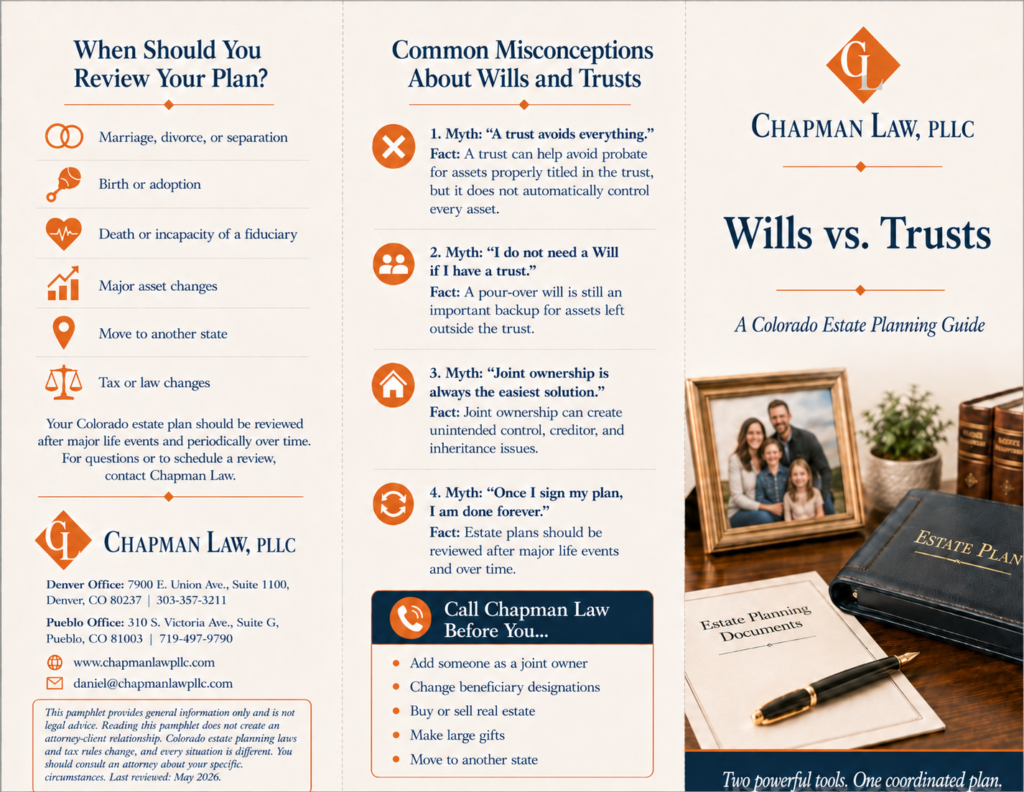
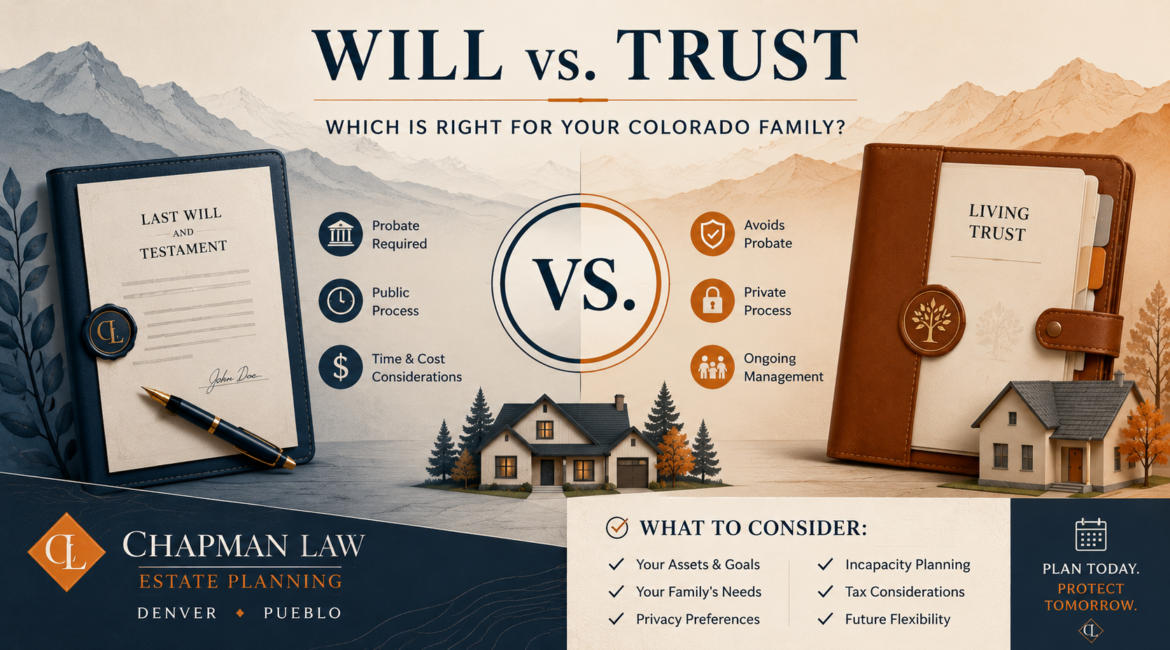
One of the most common estate planning questions we hear is also one of the hardest to answer with a quick online search: Do I need a trust in Colorado, or is a will enough?
A lot of articles make this sound like a simple choice. It usually is not. A will and a revocable living trust do different jobs. For some people, a will-based plan may be the right fit. For others, a trust is worth serious discussion. And for many Colorado families, the better answer is not one or the other. It is both, along with powers of attorney and health care documents.
If you are comparing a will vs. trust in Colorado, the best place to start is with what each document is actually designed to do.
What a will does
A will is a legal document that says who should receive your property after your death. It can also name the person you want to serve as personal representative and, if you have minor children, nominate the people you want to care for them.
That guardian nomination point is a big one. If you have young children, a will is usually an important part of the conversation even if you are also considering a trust.
A will can be the foundation of a solid estate plan, but it has limits. One of the biggest misunderstandings is probate.
Does a will avoid probate in Colorado?
Usually, no (but it depends).
A will gives instructions that are generally carried out through the probate process. It does not usually bypass probate on its own. That matters because many people searching for a Denver estate planning attorney or Pueblo estate planning attorney are really trying to solve a practical problem: how to make things easier for the people they love.
If avoiding probate is one of your main goals, a will alone may not fully accomplish that.
What a revocable living trust does
A revocable living trust is created during your lifetime. You can generally manage the assets in the trust while you are living, and the trust can provide instructions for what happens if you become incapacitated or after you pass away.
People often ask about a Colorado revocable living trust because it may help with:
- avoiding probate for properly funded trust assets
- keeping the administration more private
- creating a smoother transition if someone needs to step in and manage things
- setting clearer terms for when and how beneficiaries receive assets
That does not mean every person needs a trust. It does mean a trust is not just for wealthy families.
Are trusts only for wealthy people?
No.
That idea has stuck around for years, but it does not match how many families actually use trusts. In Colorado, a trust may be worth discussing if you own a home, want more privacy, have a blended family, want a better plan for incapacity, or want to make administration easier for the person who would be handling things later.
For a lot of families, the house is the turning point in the conversation.
If you are a homeowner, the question is often less about whether you are “rich enough” for a trust and more about whether you want a clearer plan for one of your largest assets.
When a will may be enough
There are situations where a will-based plan may be a reasonable fit.
For example, you may not need a trust-centered plan if:
- your situation is relatively simple
- your goals are straightforward
- you mainly want to name beneficiaries and guardians
- you are comfortable with the role probate may play
- you do not need added distribution controls for beneficiaries
But even then, a will should usually not be the whole plan.
A practical Colorado estate plan often includes:
- a will
- a financial (“general”) power of attorney
- a medical power of attorney
- advance directive or living will documents
- beneficiary coordination where appropriate
That is one reason Chapman Law’s estate planning page emphasizes that a last will is only part of a full estate plan, not the whole thing. Chapman Law estate planning page
When a trust may make sense
A trust is often worth a closer look when you want more than a basic transfer plan.
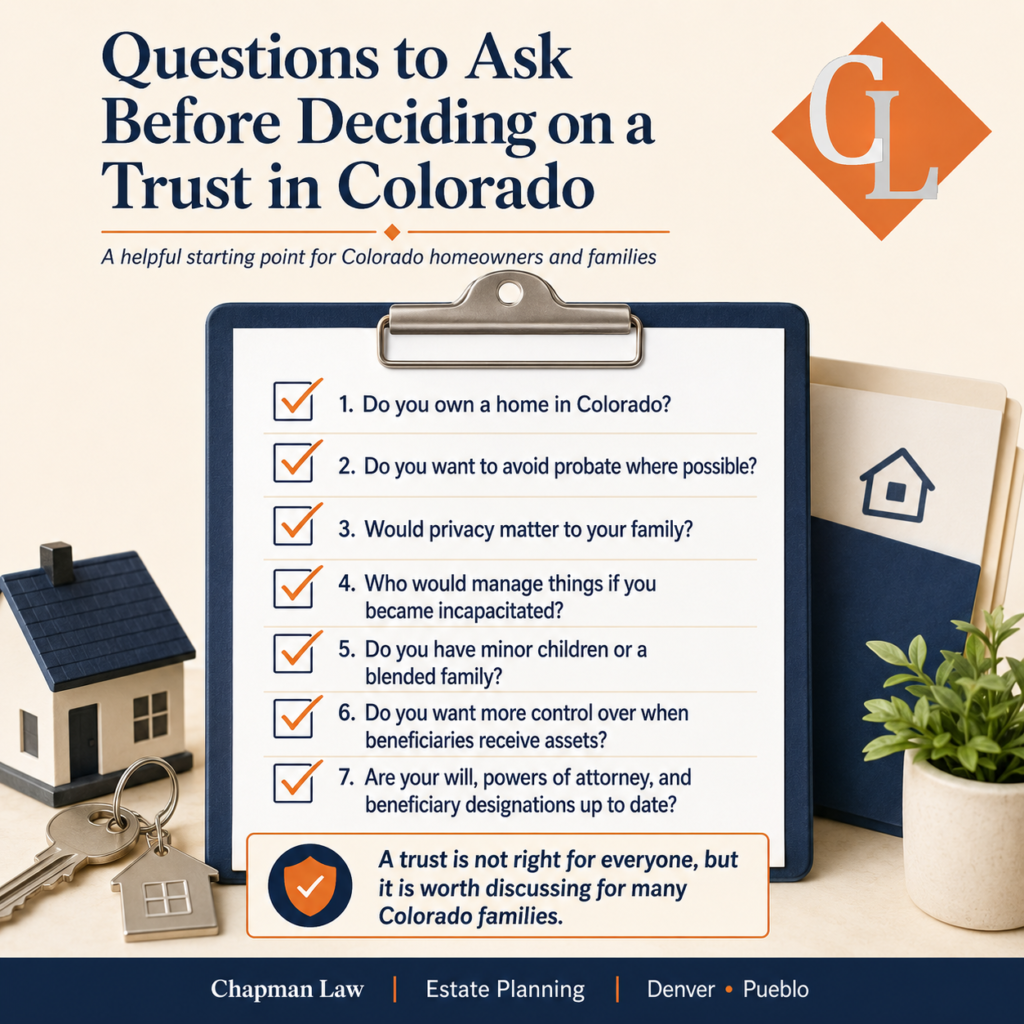
A trust may make sense if:
- you own a home or other real estate
- you want to avoid probate for certain assets
- you want more privacy for your family
- you want a clearer incapacity plan
- you are in a blended family situation
- you want more control over how assets pass to children or other beneficiaries
- you want to make administration easier for the person stepping in after you
This is especially common with Colorado families who are balancing work, homeownership, children, and aging-parent concerns all at once.
What if you have a trust? Do you still need a will?
Short answer, yes.
This surprises people, but a trust and a will usually are not competitors. They often work together.
If you have a trust, you may still need a will for reasons such as:
- naming guardians for minor children
- handling assets that were never moved into the trust
- tying the rest of the plan together
That is why many trust-based plans also include a pour-over will. In plain English, a good plan is not just about signing a trust. It is about making sure your assets, beneficiary choices, decision-makers, and supporting documents all line up.
A few real-life Colorado examples
Here are three common situations where the answer may look different.
Example 1: Parents with young children in Parker
A couple in Parker owns a home, has retirement accounts, and has two young children. Their first concern is who would care for the children and who would manage money for them if something unexpected happened.
A will is important here because it can nominate guardians. A trust may also be worth discussing if they want more control over how money is managed for the children or if they want to avoid probate for certain assets.
Example 2: A Pueblo family helping aging parents
An adult child in Pueblo is helping aging parents think through what would happen if one of them could no longer handle finances or medical decisions.
This is not just a “who gets what” question. It is also about incapacity planning. Powers of attorney and medical decision-making documents may be just as important as a will or trust in this situation. Colorado’s Judicial Legal Help Center also highlights that financial and medical powers of attorney serve different roles, which is a useful distinction for families to understand. Colorado Judicial Legal Help Center
Example 3: Homeowners who want things to be easier later
A married couple owns a house, has grown children, and wants a plan that is organized and easier for the family to carry out.
They may not need an especially complex plan, but they may want to talk through whether a revocable living trust, beneficiary designations, or other planning tools fit their goals better than relying on a will alone.
The better question to ask
A lot of people start by asking, “Which is better, a will or a trust?”
Usually, the better question is this: What kind of estate plan fits my family, my property, and the people I am relying on?
That is where a real planning conversation becomes more useful than a checklist. The right plan depends on who should make decisions, how assets are titled, whether you own real estate, whether you want to reduce probate involvement where possible, and whether your current documents still reflect your life.
Final thoughts
If you are trying to decide whether you need a trust in Colorado or whether a will is enough, there is a good chance you are already asking the right practical questions. The next step is making sure the answer fits your actual circumstances.
Chapman Law helps families in Denver, Pueblo, and throughout Colorado think through wills, trusts, powers of attorney, and related planning decisions in a practical way. Some people need a simpler will-based plan. Some need a trust-centered plan. Many need help deciding where that line is.
If you have questions about what kind of estate plan may fit your situation, Chapman Law can help you think through your options.
Information shared here is general educational information and is not legal advice. Every situation is different, and you should speak with an attorney about your specific circumstances.
For free brochure on Wills vs. Trusts click here: Wills vs. Trust Brochure Download